
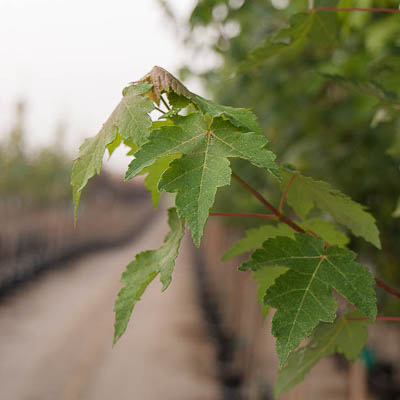
The Redpointe® Maple (Acer rubrum ‘Frank Jr.’ PP 16,769) is one of the most requested shade trees we grow. Introduced by J. Frank Schmidt & Son Co. in 2006, it combines the refined foliage and form of a strong red maple with the faster growth and urban toughness often associated with Freeman maples.
If you are weighing it against other maples—especially in the Tri-Cities, where higher soil pH can turn many red and Freeman maples yellow—this balanced look at the pros and cons should help you decide. For more of what we appreciate about the cultivar, see our earlier post, What we love about the Redpointe® Maple.
A Quick Profile
According to J. Frank Schmidt & Son Co., Redpointe® is hardy to USDA Zone 5 and matures at about 45 feet tall with a 30-foot spread. Oregon State University’s landscape plant database describes it as a fast-growing, broadly pyramidal tree with a dominant central leader, dark green summer leaves, and brilliant red fall color.
Plant it in full sun. It prefers moist, well-drained, slightly acidic soil, but it also tolerates wetter sites better than many landscape maples. That mix of size, form, and color is why it shows up so often on street-tree and shade-tree lists.
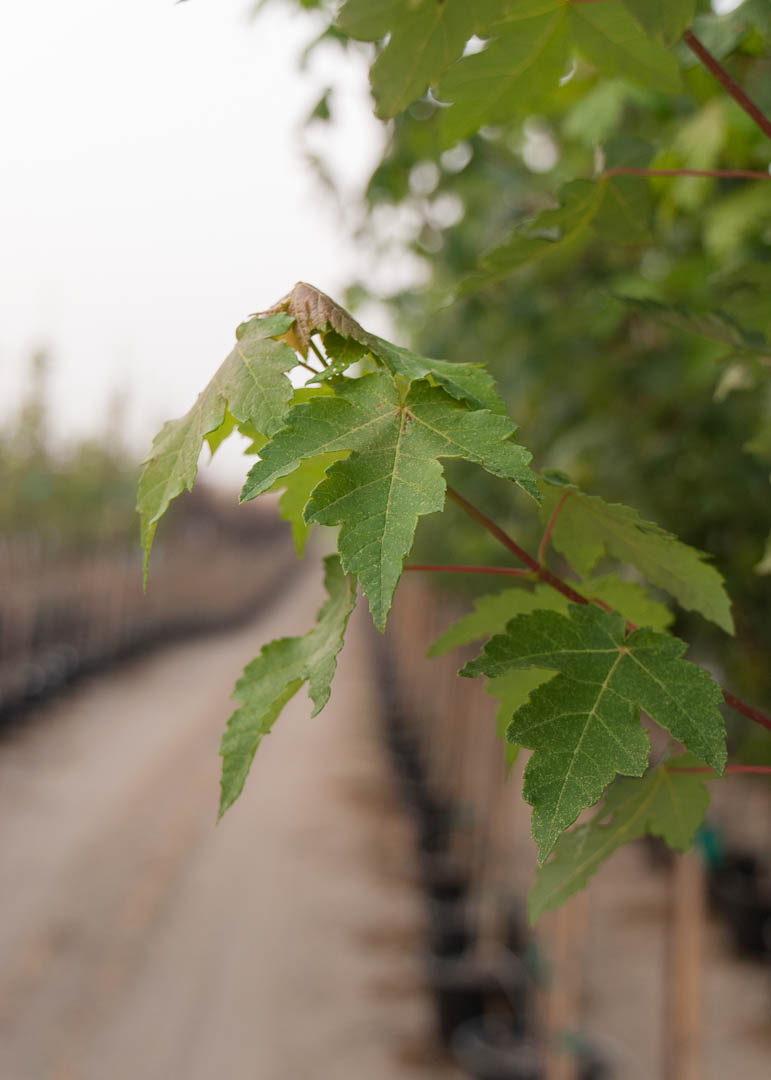
Redpointe® Maple foliage at Garden Gate Nursery.
Pros of the Redpointe® Maple
Reliable red fall color and handsome summer foliage
Redpointe® was selected for deep green summer leaves that hold up in heat, then turn a vivid red in autumn. That consistent color show is the main reason many homeowners choose it over more variable seedlings or cultivars that fade to mixed orange and yellow.
Strong central leader and easier structure
J. Frank Schmidt notes that a straight, dominant central leader produces strong branch angles that make the tree easier to grow and train. In practice, that means a more predictable pyramidal canopy and less corrective pruning than maples that develop competing leaders or narrow crotches early on.
Faster growth with urban toughness
Redpointe® brings together the look of a refined red maple with growth and street-tree durability closer to Acer × freemanii. It adapts well to typical urban stresses—including pollution—and keeps a tidy upright habit that works along streets, in larger front yards, and as a lawn shade tree.
Heat, drought, and wet-site tolerance
The Pennsylvania Horticultural Society’s Gold Medal Plant program, as quoted by J. Frank Schmidt, describes Redpointe® as a tree that “possesses an improved branching habit and is great at enduring heat and drought.” The same profile notes that it “thrives best in well-drained, moist, rich, slightly acidic soil, but is also tolerant of wet conditions.” Once established, that flexibility is a real advantage in variable landscapes.
Better disease, insect, and chlorosis performance
Compared with many red maples, Redpointe® has improved resistance to anthracnose, spider mites, and leafhoppers. Just as important in our region: it handles higher pH soils better than favorites like Autumn Blaze®. In Tri-Cities plantings, we regularly see Autumn Blaze yellow out when soil pH climbs above about 7, while Redpointe® stays greener through the summer. That chlorosis tolerance is one of the strongest local reasons to plant it.
Low maintenance and award-winning reputation
Uniform growth and a well-behaved canopy keep maintenance modest for a tree of this size. In 2025, Redpointe® was named a PHS Gold Medal Plant—recognition for ease of cultivation, multi-season interest, and landscape performance beyond the Mid-Atlantic region where the award focuses.
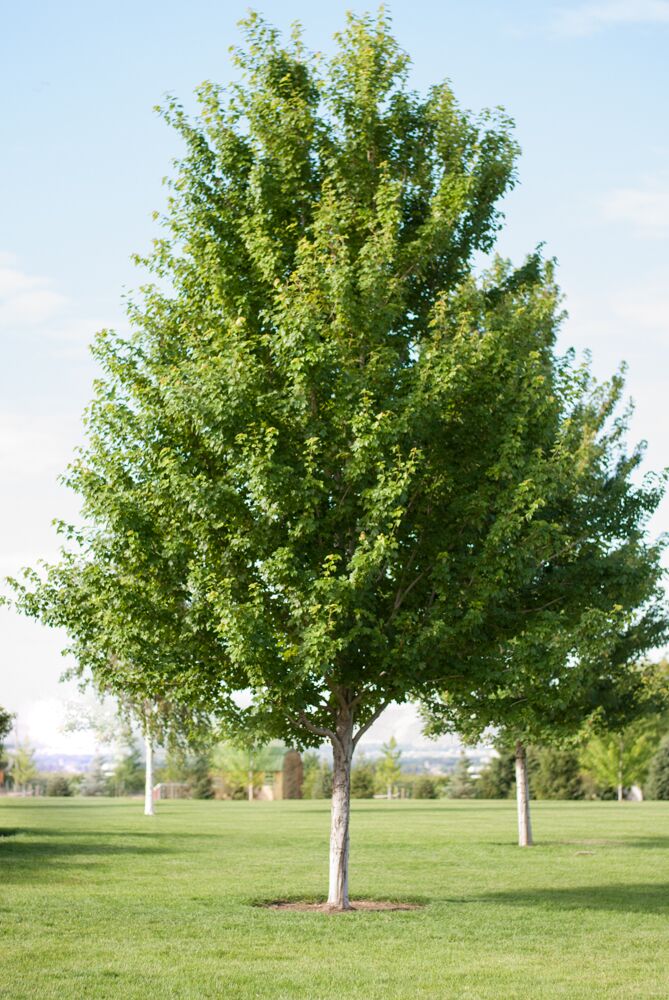
Semi-mature Redpointe® Maples in a Tri-Cities landscape.
Cons of the Redpointe® Maple
It needs room
At roughly 45 feet tall and 30 feet wide, Redpointe® is not a small-yard tree. Tight side yards, narrow planting strips, and spaces under utility lines are poor fits. Give it canopy and root space up front, or choose a smaller ornamental maple instead.
Zone 5 hardiness has limits
Hardy to USDA Zone 5, Redpointe® is less cold-tolerant than some shade trees that push into Zones 3 or 4. For most of Washington’s lower Columbia Basin that is not an issue, but gardeners in colder pockets should confirm winter lows before planting.
Young trees still need structural pruning
Even with an improved branching habit, large maples benefit from early formative pruning. Plan on a few summers of selecting a strong leader, removing rubbing limbs, and raising the canopy as needed. Skip that early work and you may face denser interior branching later.
Soil preference is still real
Higher pH tolerance is a strength of this cultivar, not a free pass. Redpointe® still performs best in moist, slightly acidic, fertile soil. Extremely alkaline or nutrient-poor sites may need soil improvement, careful watering, and realistic expectations—especially while the tree is establishing.
Shallow maple roots and leaf litter
Like other maples, Redpointe® tends toward a relatively shallow root system. Planted too close to sidewalks, driveways, or thin turf, those roots can compete for water and nutrients and complicate hardscape over time. Fall also brings a full season of leaf cleanup, the ordinary tradeoff for that brilliant red display.
Fast growth still requires long-term care
Faster growth is a pro when you want shade sooner, but it also means the tree puts on size quickly. Site it with maturity in mind, water it well through the first several seasons, and keep up with pruning so structure stays sound as the canopy fills in.
Is Redpointe® Right for You?
Choose Redpointe® if you have space for a medium-large shade tree, want dependable red fall color, and need a maple that holds greener foliage in higher pH soils than many red or Freeman maples. It is especially compelling in Tri-Cities and similar alkaline-leaning landscapes where chlorosis has disappointed you with other cultivars.
Look elsewhere if your planting area is small, you need deeper cold hardiness than Zone 5, or you prefer a compact ornamental over a full-sized canopy tree. If chlorosis is less of a concern and you simply want a familiar Freeman maple look, Autumn Blaze® remains popular—but in our experience Redpointe® is the better bet when soil pH runs high.
See Redpointe® Maple in our catalog to check current sizes and availability, or stop by the nursery and we can help you match the right maple to your site.
Sources
J. Frank Schmidt & Son Co. — Redpointe® Maple: https://jfschmidt.com/all-trees/introductions/redpointe-maple/
J. Frank Schmidt & Son Co. — Redpointe® Maple earns gold in 2025: https://jfschmidt.com/articles/redpointe-maple-earns-gold-in-2025/
Oregon State University Landscape Plants — Acer rubrum Redpointe®: https://landscapeplants.oregonstate.edu/plants/acer-rubrum-redpointe