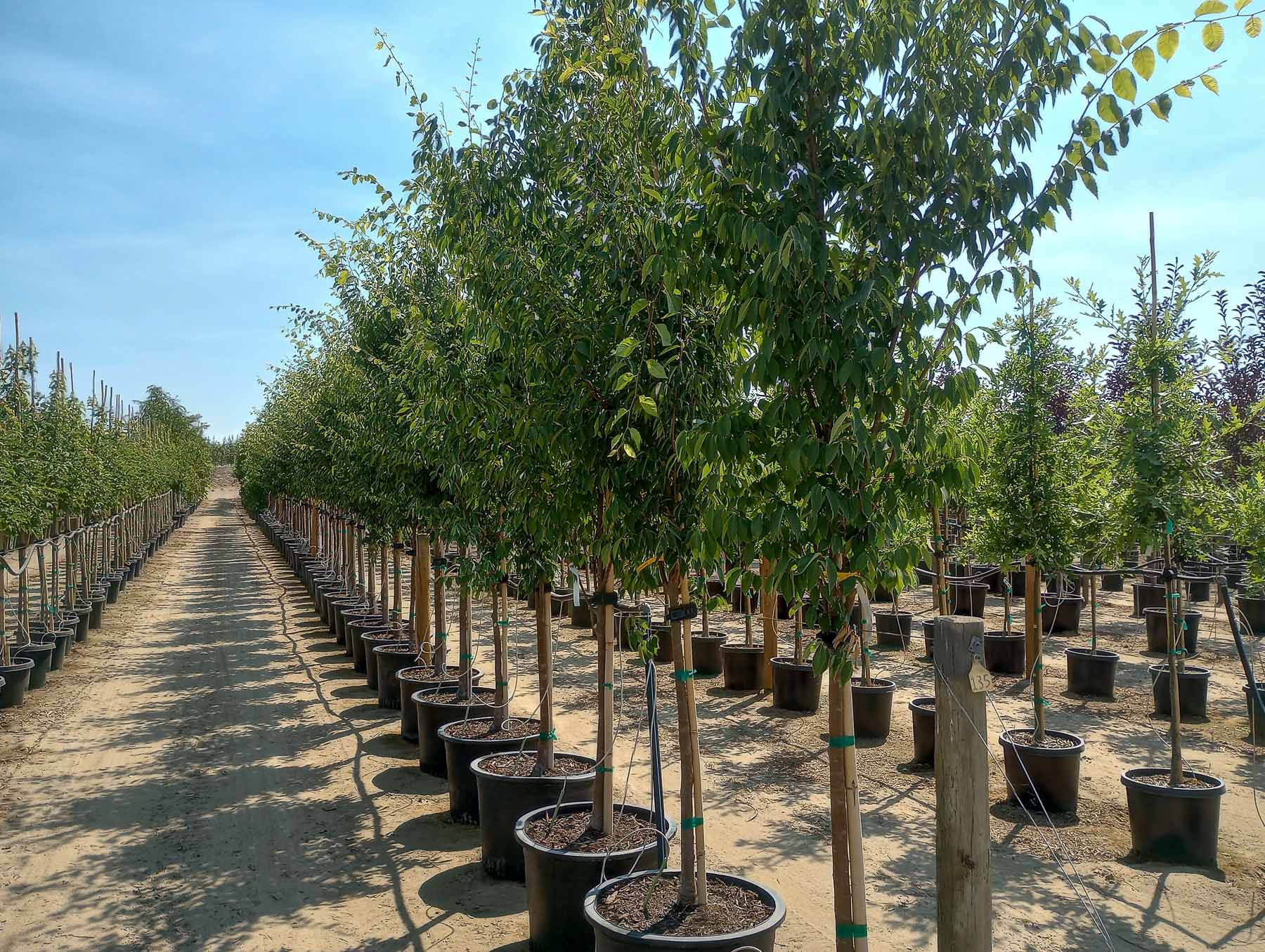
Japanese Zelkova (Zelkova serrata) is one of the most useful shade and street trees we grow. Closely related to elms in the Ulmaceae family, it offers a graceful vase-shaped canopy, clean serrated foliage, and attractive bark—without the Dutch elm disease vulnerability that devastated American elms. The Morton Arboretum and North Carolina State Extension both highlight it as a tough urban performer and a popular elm alternative.
If you are weighing a Zelkova against other shade trees for a yard, parking strip, or commercial site, this balanced look at the benefits, pros, and cons should help. We also grow five distinct cultivars, so you can match form and size to the planting space rather than planting the species at large.
A Quick Profile
According to Oregon State University’s landscape plant database, Japanese Zelkova is a broadleaf deciduous tree that typically matures around 50–60 feet (sometimes taller), with a vase-shaped habit and low branching. Leaves are dark green and elm-like, with sharply serrated margins; fall color is variable and may range from yellow and orange-bronze to red or reddish purple. Bark starts smooth and gray, then becomes more mottled and slightly exfoliating with age.
Plant it in full sun. It prefers moist, deep, well-drained soil and is pH adaptable. Once established, it is wind and drought tolerant. Cultivars are generally hardy to USDA Zone 5. That mix of form, toughness, and disease resistance is why zelkovas show up so often on street-tree and shade-tree lists—including our own roundup of the best shade trees.
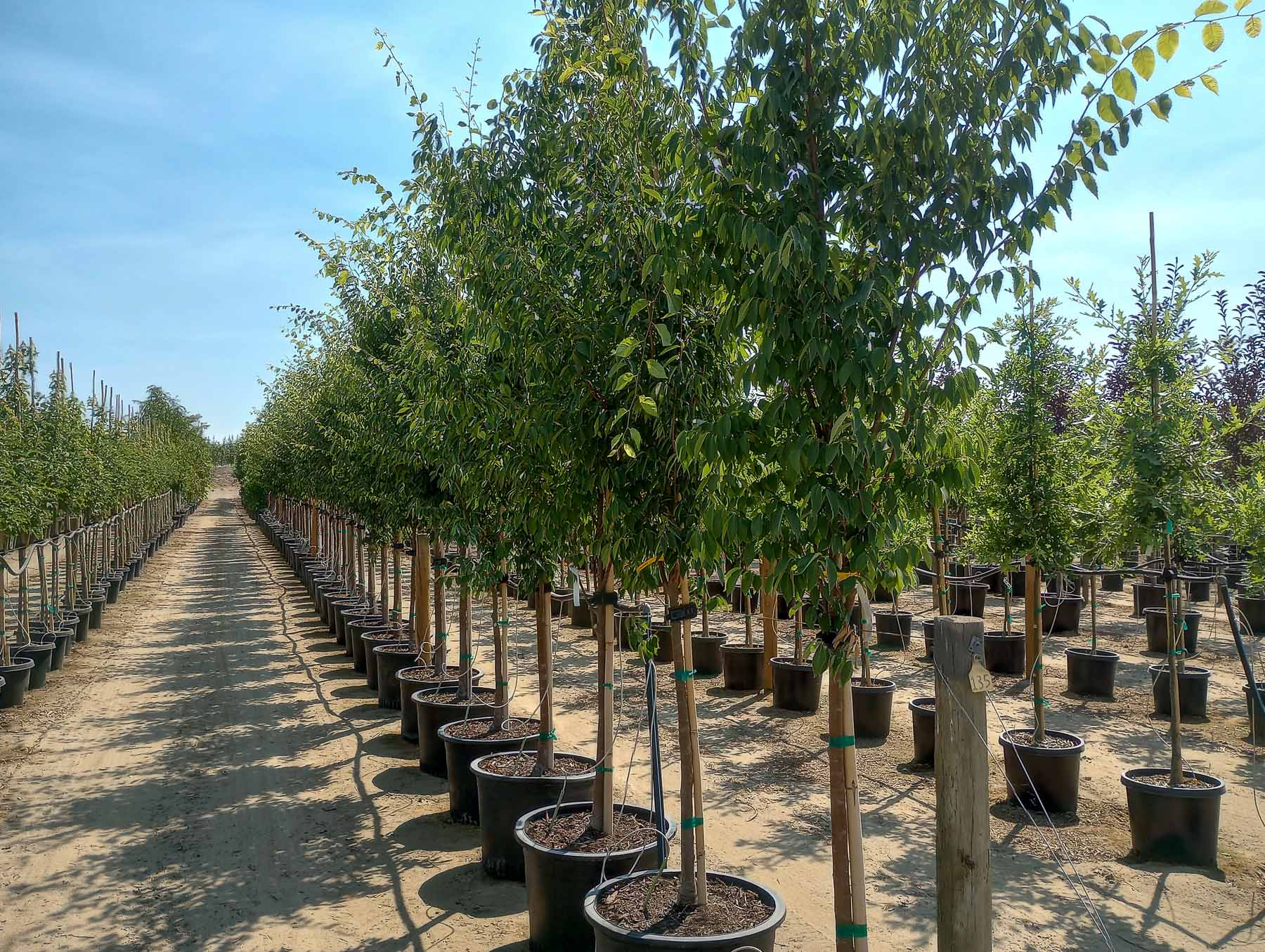
Musashino Columnar Zelkova at Garden Gate Nursery.
Benefits of Planting a Zelkova
An elm-like vase without Dutch elm disease
Zelkova has been promoted for years as a substitute for American elm because of its vase shape and canopy character. Critically, it is resistant to Dutch elm disease and to elm leaf beetle—two problems that limited elm plantings for decades. You get much of the silhouette people love about elms, with a far better disease profile.
Urban toughness and drought tolerance
The Morton Arboretum notes that Japanese Zelkova tolerates urban conditions well and can be used as a street tree. It handles alkaline soil, clay, dry sites, occasional drought, and road salt. North Carolina State Extension adds that established trees are drought and wind tolerant. That combination matters in parking lots, downtown planting pits, and other challenging urban sites.
Multi-season interest
Summer foliage is clean and finely textured. Fall color, while variable by cultivar, can deliver yellow, orange, bronze, or red. Mature bark develops a mottled, honeycomb character that adds winter interest when leaves are gone. Flowers are inconspicuous; the show is foliage, form, and bark.
Flexible sizes through cultivars
The species itself is a large tree. Cultivars, though, range from low and wide under utility lines to narrow columnar forms for tight streets. That cultivar range is a real benefit: you can keep the Zelkova look while fitting the site. We grow five of those selections and cover each below.
Pros of Zelkova Trees
Reliable shade and a refined canopy
The upright-arching, vase-shaped habit produces a broad canopy of dappled to moderate shade. On streets planted at reasonable spacing, crowns can eventually meet and create a continuous shaded corridor—one reason cities and campuses keep planting them.
Strong pest and disease resistance
Compared with American elm, Zelkova’s resistance to Dutch elm disease and elm leaf beetle is a major advantage. University of Florida IFAS describes it as almost pest-free in typical landscape use, and notes resistance to verticillium wilt as well. That does not mean zero maintenance, but it does mean fewer chronic elm-related headaches.
Adaptable soils once established
Zelkova prefers moist, deep loam, but it tolerates sand, clay, and soils with pH into the slightly alkaline range (about 7.5 according to IFAS). Established trees need less irrigation except on very sandy sites. That adaptability helps when soil chemistry is less than ideal.
Transplant and street-tree durability
The Morton Arboretum lists Japanese Zelkova as transplanting well. IFAS calls it a tough urban tree suited to restricted-soil tree pits and downtown streets. Cultivars selected for urban use—especially compact and columnar forms—extend that durability into tighter sites.
Low litter from fruit
Fruits are small and not considered a litter problem. You still get seasonal leaf drop in fall, but you avoid the messier fruit or seed issues of some large shade trees.
Cons of Zelkova Trees
Many cultivars still need room
Species-type and large vase cultivars can mature well over 40 feet tall and wide. Tight side yards, narrow planting strips, and spaces under low utility lines are poor fits for Green Vase® or Village Green™. Choose a compact or columnar cultivar—or a different genus—when space is limited.
Ice and branch breakage risk
The Morton Arboretum flags Japanese Zelkova as highly susceptible to ice damage. IFAS notes susceptibility to breakage and warns that branches often clump together on the trunk, with double leaders and included bark common if trees are not trained early. Insist on good nursery structure and plan on formative pruning.
Early structural pruning is not optional
Even strong cultivars benefit from early training: spaced branches, a clear leader where appropriate, and limbs kept well below half the trunk diameter. Skip that work and you may face weaker attachments and denser, clumped branching later—especially on street trees that need vehicle and pedestrian clearance.
Canker risk after trunk wounds
IFAS notes that Zelkova is subject to canker diseases particularly when the trunk is repeatedly wounded. Avoid lawn-mower and string-trimmer damage, and keep the tree healthy so wounds heal cleanly.
Fall color is cultivar-dependent
Fall color on the species is variable. If you need a predictable red or yellow display, pick a cultivar known for that color rather than planting an unnamed seedling or expecting every tree to match a photo.
Not a perfect American elm clone
OSU notes that while Zelkova is resistant to Dutch elm disease, it has not fully gained acceptance as a one-for-one substitute for American elm’s grace. It is an excellent tree on its own merits—just set expectations accordingly.
Zelkova Varieties We Grow
We grow five Zelkova serrata cultivars so you can match height, spread, and habit to the site. Specs below are from J. Frank Schmidt & Son Co., which introduced or popularized several of these selections. Check each catalog page for current sizes and availability.
Wireless® Zelkova
Wireless® Zelkova (Zelkova serrata ‘Schmidtlow’) is selected for an unusually low height and broad, horizontally spreading habit—about 24 feet tall and 36 feet wide, hardy to Zone 5. Vivid red fall color is a bright bonus. As the name suggests, it is a strong fit for street plantings beneath utility lines and for parking lots where you want shade without blocking signs or power lines. We also featured it in What are the best shade trees?.
Best for: under power lines, wide parking-lot islands, and low-canopy shade.
Green Vase® Zelkova
Green Vase® Zelkova (Zelkova serrata ‘Green Vase’) is a vigorous selection at about 44 feet tall and 30 feet wide (Zone 5), with a vase of upright arching branches. J. Frank Schmidt describes it as taller and more graceful than Village Green™, with finer-textured foliage that produces dappled shade. OSU and IFAS both note its popularity as a city street tree and its more upright habit relative to Village Green™.
Best for: larger yards, parkways, and street plantings where you want a classic tall vase form.
City Sprite® Zelkova
City Sprite® Zelkova (Zelkova serrata ‘JFS-KW1’ PP 20,996) is compact, dense, and semi-dwarf—about 24 feet tall and 18 feet wide, Zone 5. Summer foliage appears brighter green than typical Zelkova. Short internodes, fine-textured leaves, and a tidy oval-to-vase habit make it a low-maintenance choice for tight urban spaces. Fall color is yellow.
Best for: small yards, narrow planting strips, and other sites that cannot take a full-sized shade tree.
Musashino Columnar Zelkova
Musashino Columnar Zelkova (Zelkova serrata ‘Musashino’) is a very narrow upright vase—about 45 feet tall and only 15 feet wide, Zone 5. Tightly upright branches allow good vehicle and pedestrian clearance under a delicate green canopy, which is why it works so well on narrow streets. The Society of Municipal Arborists named it Urban Tree of the Year in 2016 for its adaptability to harsh urban conditions. We have also recommended it for plantings around solar farms where a tall, narrow screen is useful.
Best for: narrow streets, screening, and tight side yards where width is the limiting factor.
Village Green™ Zelkova
Village Green™ Zelkova (Zelkova serrata ‘Village Green’) is a widely used cultivar at about 40 feet tall and 40 feet wide, Zone 5. J. Frank Schmidt describes it as more upright and faster growing than the species, with very dense, dark green foliage and a clean appearance. OSU notes a rounded vase shape and rusty-red fall color; IFAS adds that it tends to be more winter hardy than Green Vase® and may have a straighter trunk.
Best for: lawn shade trees and street plantings where you want a denser, broader canopy than Green Vase®.
Is a Zelkova Right for You?
Choose a Zelkova if you want vase-shaped shade, urban toughness, and resistance to Dutch elm disease—and if you can match the cultivar to your space. Wireless® and City Sprite® keep height in check; Musashino stays narrow; Green Vase® and Village Green™ deliver the full elm-like street-tree presence.
Look elsewhere if your planting area cannot accommodate even a compact cultivar, if ice-storm breakage is a major local concern and you prefer a more breakage-resistant genus, or if you need a true American elm character that no Zelkova fully replaces. For early care, our tree planting care guide covers watering and establishment that apply to any of these cultivars.
Browse Village Green™, Green Vase®, Wireless®, City Sprite®, or Musashino in our catalog to check current sizes and availability—or stop by the nursery and we can help you match the right Zelkova to your site.
Sources
The Morton Arboretum — Japanese zelkova (Zelkova serrata): https://mortonarb.org/plant-and-protect/trees-and-plants/japanese-zelkova/
North Carolina Extension Gardener Plant Toolbox — Zelkova serrata: https://plants.ces.ncsu.edu/plants/zelkova-serrata/
University of Florida IFAS — Zelkova serrata: Japanese Zelkova: https://edis.ifas.ufl.edu/publication/st677
Oregon State University Landscape Plants — Zelkova serrata: https://landscapeplants.oregonstate.edu/plants/zelkova-serrata
J. Frank Schmidt & Son Co. — Wireless® Zelkova: https://jfschmidt.com/all-trees/introductions/wireless-zelkova/
J. Frank Schmidt & Son Co. — City Sprite® Zelkova: https://jfschmidt.com/all-trees/introductions/city-sprite-zelkova/
J. Frank Schmidt & Son Co. — Green Vase® Zelkova: https://jfschmidt.com/all-trees/green-vase-zelkova/
J. Frank Schmidt & Son Co. — Village Green™ Zelkova: https://jfschmidt.com/all-trees/village-green-zelkova/
J. Frank Schmidt & Son Co. — Musashino Columnar Zelkova: https://jfschmidt.com/all-trees/musashino-columnar-zelkova/
J. Frank Schmidt & Son Co. — Here’s the skinny on columnar trees (Musashino Urban Tree of the Year note): https://jfschmidt.com/nursery-news/heres-the-skinny-on-columnar-trees/