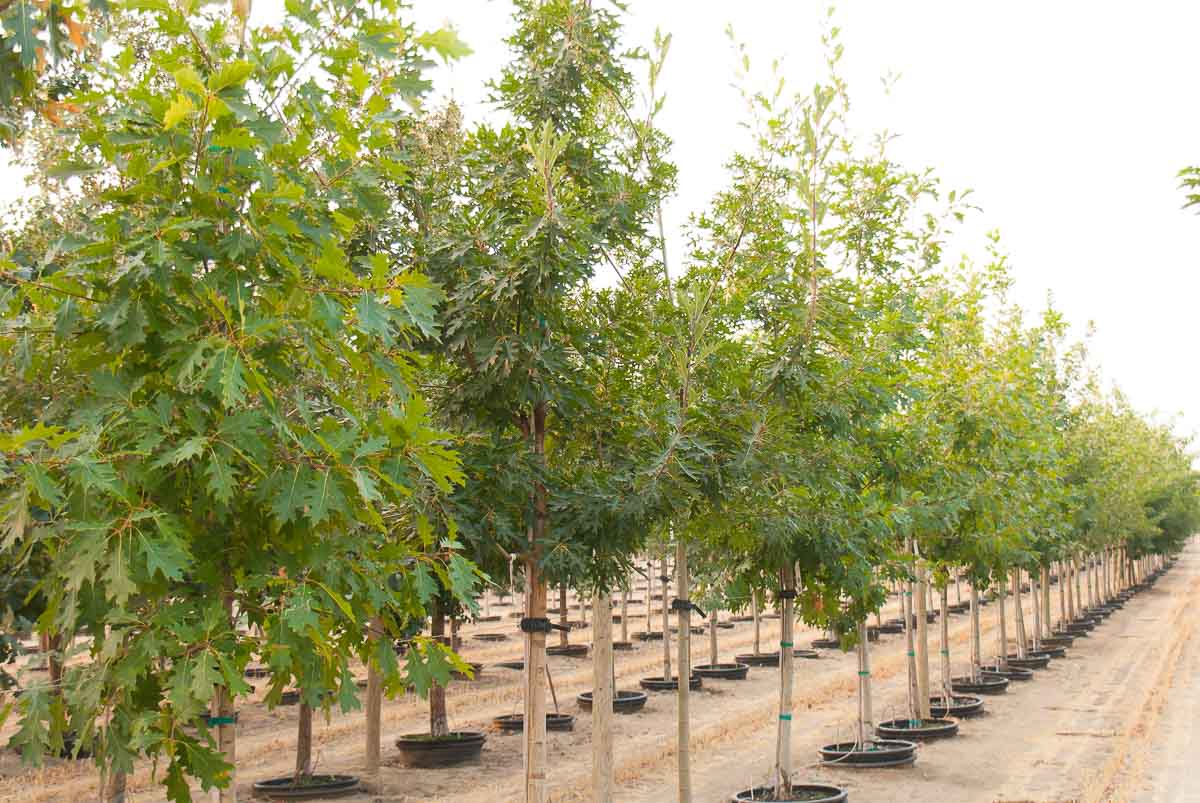
There is no single best shade tree. The right canopy depends on how much room you have, whether you want dense lawn shade or filtered light, how alkaline your soil is, and how cold your winters get.
This is an updated look at shade-tree suggestions—not a ranked list, and not the 2019 “best of” roundup that used to live at this URL. The varieties below are larger trees we grow (about 40 feet and up at maturity), currently in good supply in our shade catalog, and consistently described by horticulture sources as dependable for shade, disease resistance, and cold hardiness. Inventory changes through the season, so check the catalog or current availability before you specify a size.
We did not lead with ash, because of emerald ash borer. We also did not lead with Autumn Blaze® or pin oak: both can chlorose in the higher-pH soils common around the Tri-Cities. For more on that, see maple chlorosis in Tri-Cities.
Red Oak
Red Oak (Quercus rubra) is a long-lived, round-crowned canopy tree. Our catalog lists about 50 feet tall and 50 feet wide, hardy to USDA Zone 4, with red and yellow fall color and a medium growth rate.
The Morton Arboretum calls it one of the faster-growing oaks for home landscapes and notes salt and air-pollution tolerance that make it useful in more exposed sites. It is a genuine shade tree: broad, durable, and built for parks, large lawns, and open yards.
Caveat: Red oaks are susceptible to oak wilt in parts of the country where that disease is established. Prune in the dormant season. Morton also notes chlorosis in high-pH soils, so if your Columbia Basin soil tests very alkaline, give the tree good soil preparation and realistic expectations—or look at the pH-tougher options below.
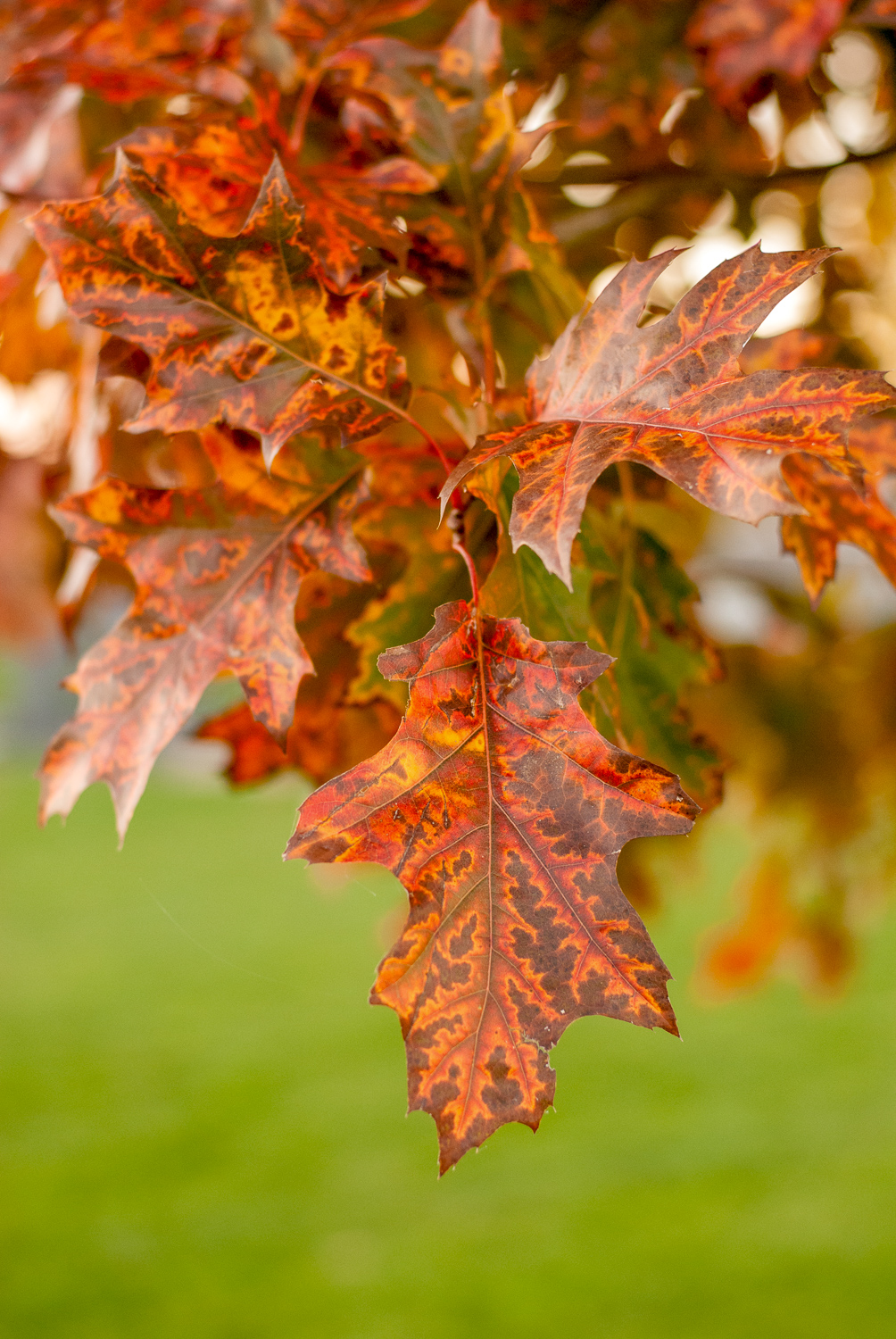
Red oak foliage in autumn.
Redpointe® Maple
Redpointe® Maple (Acer rubrum ‘Frank Jr.’) is a broadly pyramidal red maple at about 45 feet tall and 30 feet wide, hardy to Zone 5. J. Frank Schmidt selected it for a dominant central leader, dark green summer foliage, and reliable red fall color.
Compared with many red and Freeman maples, it has improved notes for anthracnose, spider mites, and leafhoppers—and it holds greener foliage in higher-pH soils than Autumn Blaze® often does here. That mix of shade, form, and chlorosis tolerance is why it is one of the maples we suggest most often for Tri-Cities lawns and streets.
It still needs room, and Zone 5 is not as cold-hardy as some trees on this list. For a fuller look at tradeoffs, see Redpointe Maple, pros and cons.
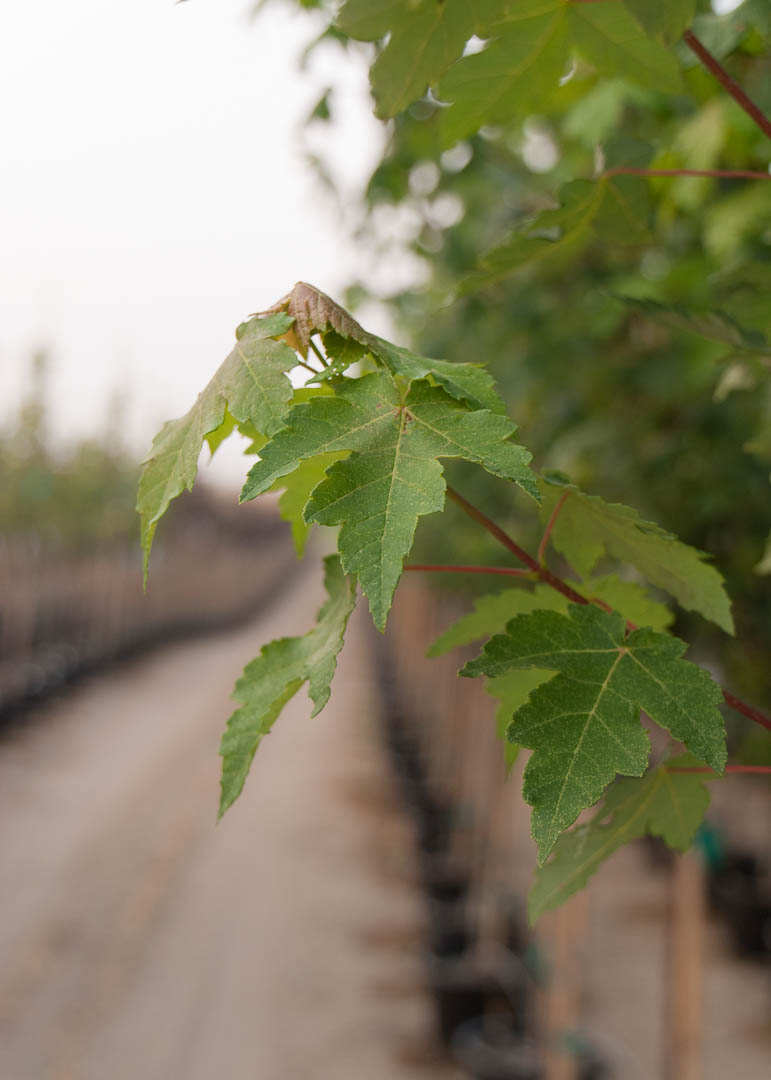
Redpointe® Maple foliage at Garden Gate Nursery.
Common Hackberry
Common hackberry (Celtis occidentalis) is a tough urban shade tree at about 45 feet tall and 35 feet wide in our catalog, hardy to Zone 3. Deep roots reduce the chance of lifting sidewalks compared with many shallow-rooted street trees, and the corky bark adds winter interest.
The Morton Arboretum lists it for parkways and large sites and notes tolerance of alkaline soil, drought, clay, road salt, and wet soils. UF/IFAS describes it as resistant to pests and diseases overall, including Verticillium wilt. Cold hardiness is a real strength: sources range from Zone 2 to 3.
Caveat: Nipple gall and witches’-broom are common and mostly cosmetic. Hackberry can also be susceptible to ice breakage, so early structural pruning matters. If you want a refined specimen with no leaf quirks, this may not be your first pick. If you want a tree that shrugs off heat, cold, and poor soil, it is hard to beat.
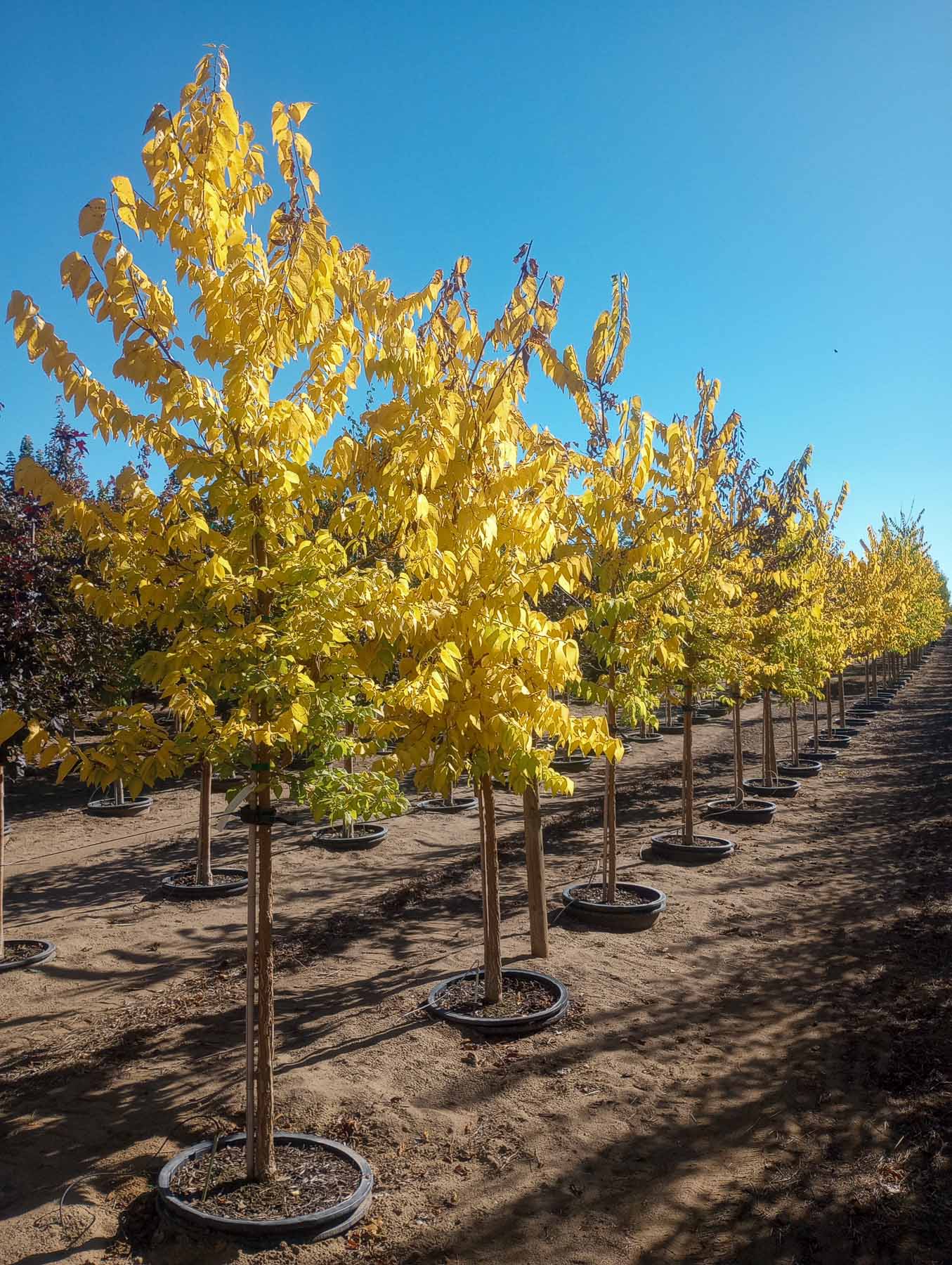
Hackberry in fall at Garden Gate Nursery, Pasco, Washington.
Skyline® Honeylocust
Skyline® Honeylocust (Gleditsia triacanthos f. inermis ‘Skycole’) is a thornless, nearly seedless honeylocust at about 40 feet tall and 30 feet wide, hardy to Zone 4. Fine compound leaflets cast filtered shade rather than a dense dark canopy, which is useful over lawns and patios that still need some light.
Missouri Botanical Garden lists Skyline as a shade and street tree that tolerates drought, clay, urban conditions, and heat. Our catalog highlights heat and wind tolerance and a pyramidal-to-rounded form that works on streets. Once established, it is one of the faster ways to get summer shade in a hot, windy Columbia Basin yard.
Caveat: “Filtered” is the point, not a flaw—but it is the wrong tree if you want deep, cool shade. Honeylocusts can see webworms, mites, and canker under stress. Site it in full sun with decent soil volume, and do not treat it as a zero-maintenance tree.
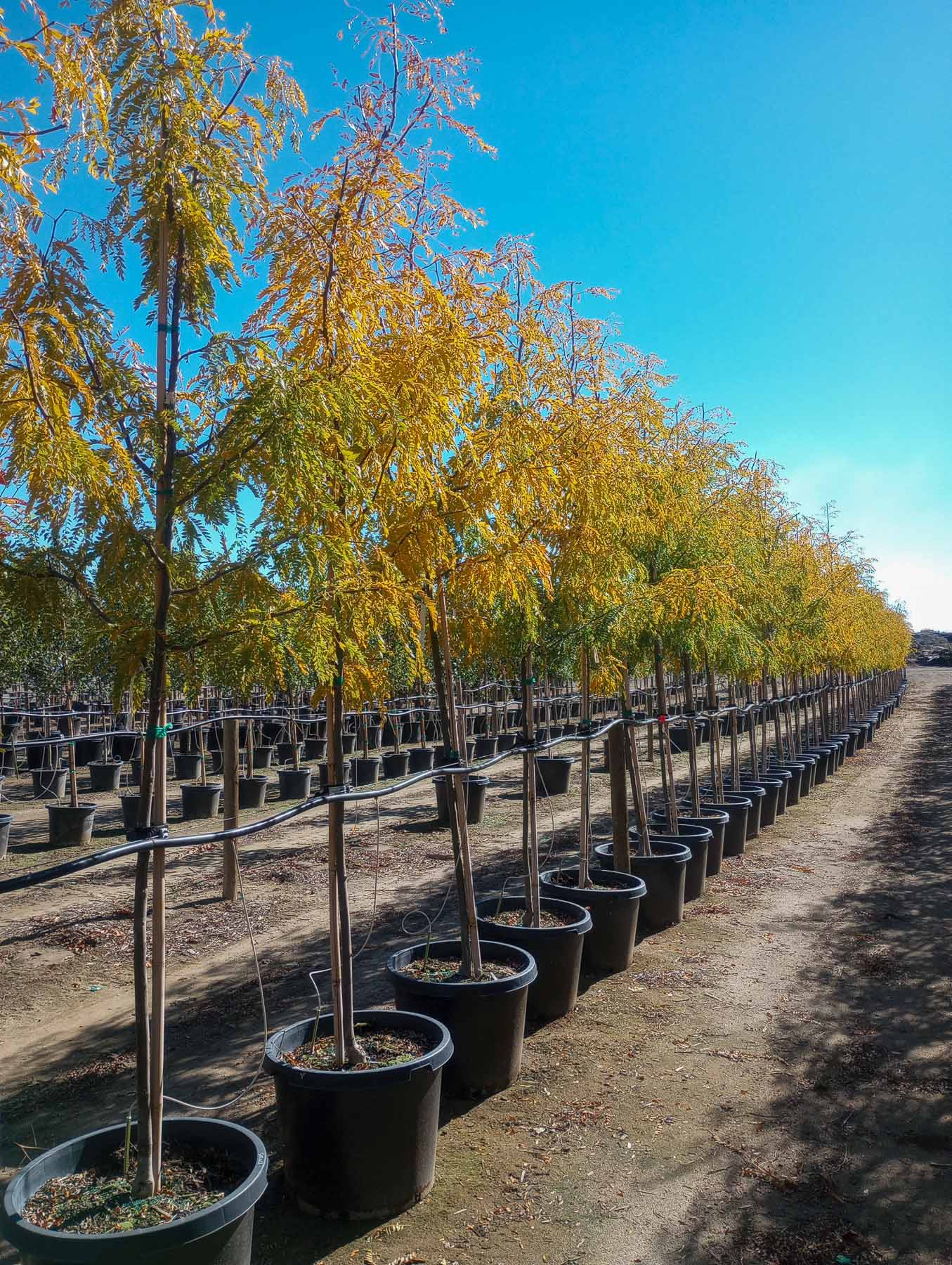
Skyline® Honeylocust in fall at Garden Gate Nursery.
Harvest Gold Linden
Harvest Gold Linden (Tilia cordata × mongolica ‘Harvest Gold’) is a hybrid linden at about 40 feet tall and 30 feet wide, hardy to Zone 3. Glossy summer foliage turns bright gold in fall. It was selected in Manitoba for cold climates, exfoliating bark, and consistent autumn color.
Cornell’s woody plants database notes no serious disease or pest problems on this cultivar, with leaves resistant to mites and fungal leaf spot, plus better cold tolerance than many lindens. If you need a dense, formal shade tree for a boulevard or larger front yard—and extra winter hardiness—this is a strong suggestion. Greenspire® Linden is a similar pyramidal option; see our earlier Greenspire profile.
Caveat: Lindens can attract aphids (and the sticky honeydew that follows) and Japanese beetles in some regions. Harvest Gold’s foliage notes are better than average, but it is still a linden: plant it where a dense, somewhat formal canopy fits.
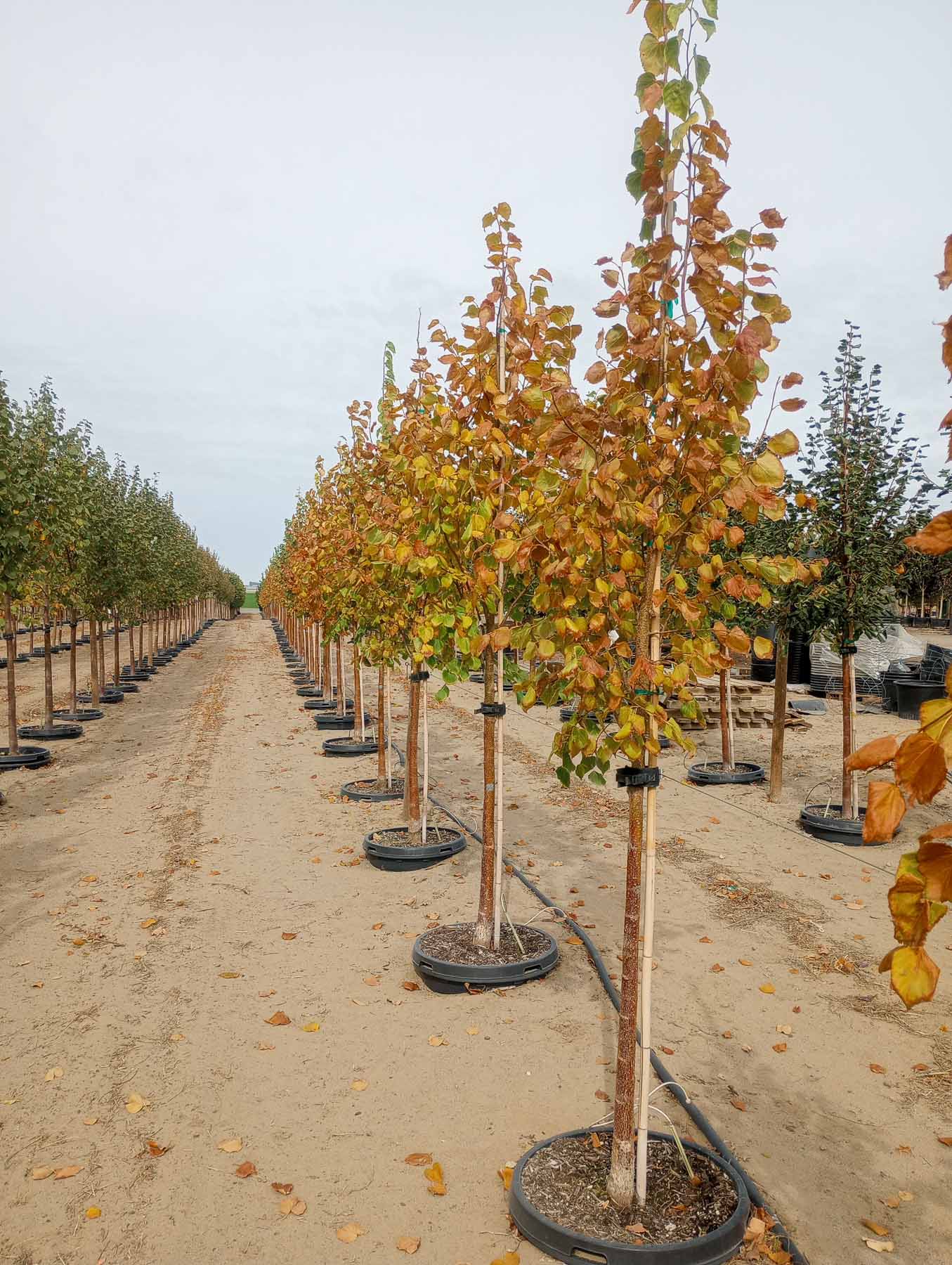
Harvest Gold Linden in fall.
Green Vase® Zelkova
Green Vase® Zelkova (Zelkova serrata ‘Green Vase’) is the large vase-shaped shade zelkova we grow. Our catalog lists about 60 feet tall and 40 feet wide, hardy to Zone 5, with a fast growth rate. Upright arching branches recall an elm silhouette without Dutch elm disease.
The Morton Arboretum and North Carolina State Extension both treat Japanese zelkova as a tough urban performer and a popular elm alternative. J. Frank Schmidt describes Green Vase as a graceful, vigorous selection with finer-textured foliage that produces dappled shade—useful on streets, parkways, and larger yards.
Caveat: Zelkovas need early structural pruning, and they can break in ice storms. Green Vase is a full-sized tree; if you need a low canopy under power lines, look at other cultivars in our zelkova pros and cons guide rather than forcing this one into a tight space.
Espresso™ Kentucky Coffee Tree
Espresso™ Kentucky Coffee Tree (Gymnocladus dioicus ‘Espresso-JFS’) grows into an oval-to-vase form about 50 feet tall and 35 feet wide, hardy to Zone 4. Bluish-green compound foliage casts filtered shade in summer and turns yellow in fall. The species is native to parts of the Midwest and is known for heat, drought, and cold tolerance once established.
J. Frank Schmidt selected Espresso as a seedless male with an elm-like silhouette and few serious pest or disease issues. The Morton Arboretum similarly describes Kentucky coffee tree as having no serious insect or disease problems—an unusual claim among large shade trees. For more on the cultivar, see Exploring the beauty and history of the Espresso™ Kentucky Coffee Tree.
Caveat: Filtered shade and a coarser winter outline are part of the look. Young trees can look sparse for a few years while the canopy fills in. This is a large, open-grown tree, not a dense maple substitute.
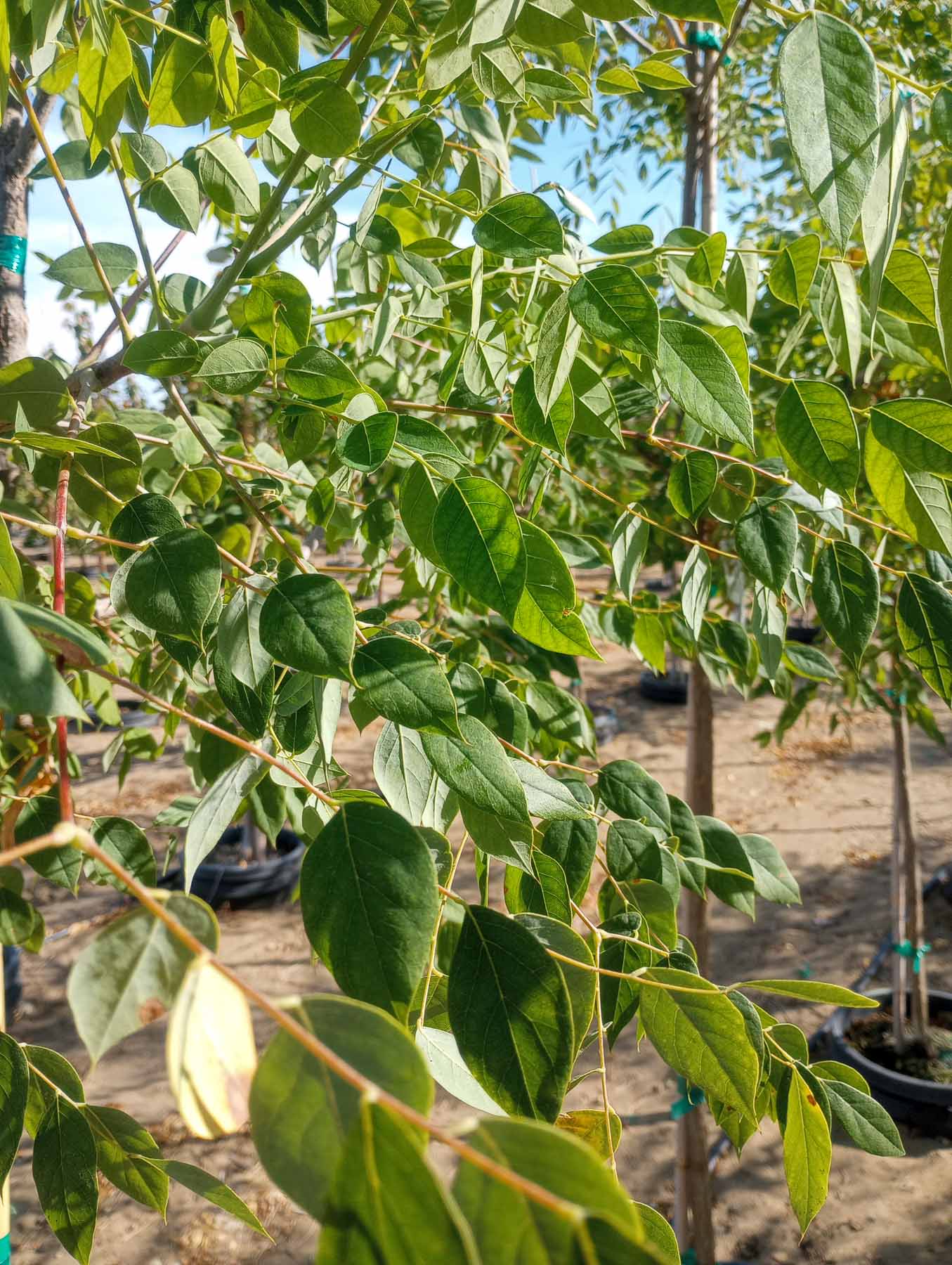
Espresso™ Kentucky Coffee Tree foliage.
How to choose among these
Match the tree to the job rather than picking a favorite name:
- Dense lawn or park shade: Red Oak, Harvest Gold Linden, Green Vase Zelkova.
- Filtered light over turf or a patio: Skyline Honeylocust or Espresso Kentucky Coffee Tree.
- Higher-pH Columbia Basin soil: Redpointe Maple, hackberry, Skyline, or Espresso tend to be more forgiving than many red maples and pin oaks.
- Coldest sites (Zone 3 and colder pockets): Hackberry and Harvest Gold Linden have the deepest hardiness on this list; Redpointe and Green Vase are Zone 5.
Browse shade trees in the catalog, download current availability, or request a quote when you are ready to specify sizes. If you are unsure which canopy fits the site, we can help you narrow it from space, soil, and the kind of shade you actually want.
Sources
The Morton Arboretum — Northern red oak: https://mortonarb.org/plant-and-protect/trees-and-plants/northern-red-oak/
The Morton Arboretum — Hackberry: https://mortonarb.org/plant-and-protect/trees-and-plants/hackberry/
The Morton Arboretum — Japanese zelkova: https://mortonarb.org/plant-and-protect/trees-and-plants/japanese-zelkova/
The Morton Arboretum — Kentucky coffeetree: https://mortonarb.org/plant-and-protect/trees-and-plants/kentucky-coffeetree/
Missouri Botanical Garden Plant Finder — Skyline honeylocust: https://www.missouribotanicalgarden.org/PlantFinder/PlantFinderDetails.aspx?kempercode=d412
Cornell Woody Plants Database — Harvest Gold linden: https://woodyplants.cals.cornell.edu/cultivar/12143
J. Frank Schmidt & Son Co. — Redpointe® Maple: https://jfschmidt.com/all-trees/introductions/redpointe-maple/
J. Frank Schmidt & Son Co. — Green Vase® Zelkova: https://jfschmidt.com/all-trees/green-vase-zelkova/
J. Frank Schmidt & Son Co. — Espresso™ Kentucky Coffeetree: https://jfschmidt.com/all-trees/introductions/espresso/
UF/IFAS — Celtis occidentalis: Common hackberry: https://edis.ifas.ufl.edu/publication/st140